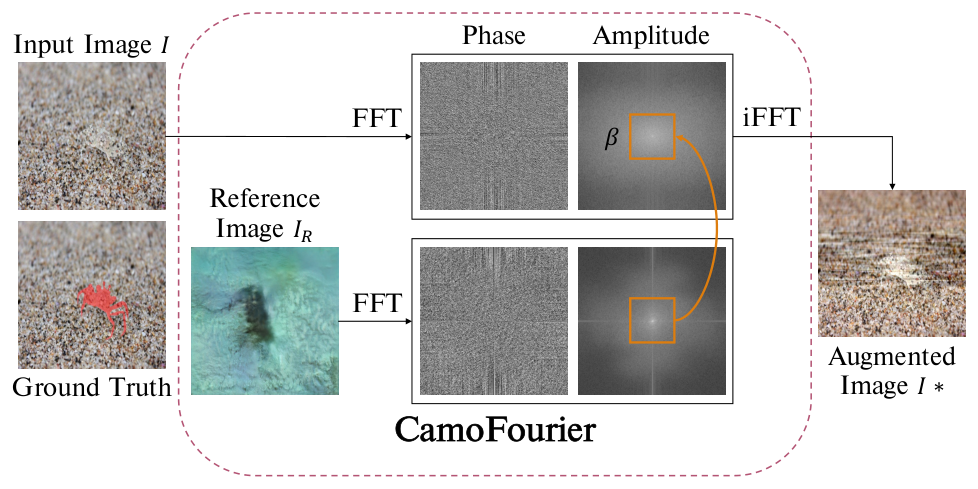
Camouflaged object detection (COD) and camouflaged instance segmentation (CIS) aim to recognize and segment objects that are blended into their surroundings, respectively. While several deep neural network models have been proposed to tackle those tasks, augmentation methods for COD and CIS have not been thoroughly explored. Augmentation strategies can help improve models' performance by increasing the size and diversity of the training data and exposing the model to a wider range of variations in the data. Besides, we aim to automatically learn transformations that help to reveal the underlying structure of camouflaged objects and allow the model to learn to identify better and segment camouflaged objects.
To achieve this, we propose a learnable augmentation method in the frequency domain for COD and CIS via the Fourier transform approach, dubbed CamoFA. Our method leverages a conditional generative adversarial network and cross-attention mechanism to generate a reference image and an adaptive hybrid swapping with parameters to mix the low-frequency component of the reference image and the high-frequency component of the input image. This approach aims to make camouflaged objects more visible for detection and segmentation models. Without bells and whistles, our proposed augmentation method boosts the performance of camouflaged object detectors and instance segmenters by large margins.
CamoFA uses a conditional generative model to create an image reference, then applies cross-attention between the input and generated images. It combines the reference image’s low-frequency Fourier amplitude with the input image’s high-frequency amplitude, preserving the input phase; an adaptive parameter controls the swap.
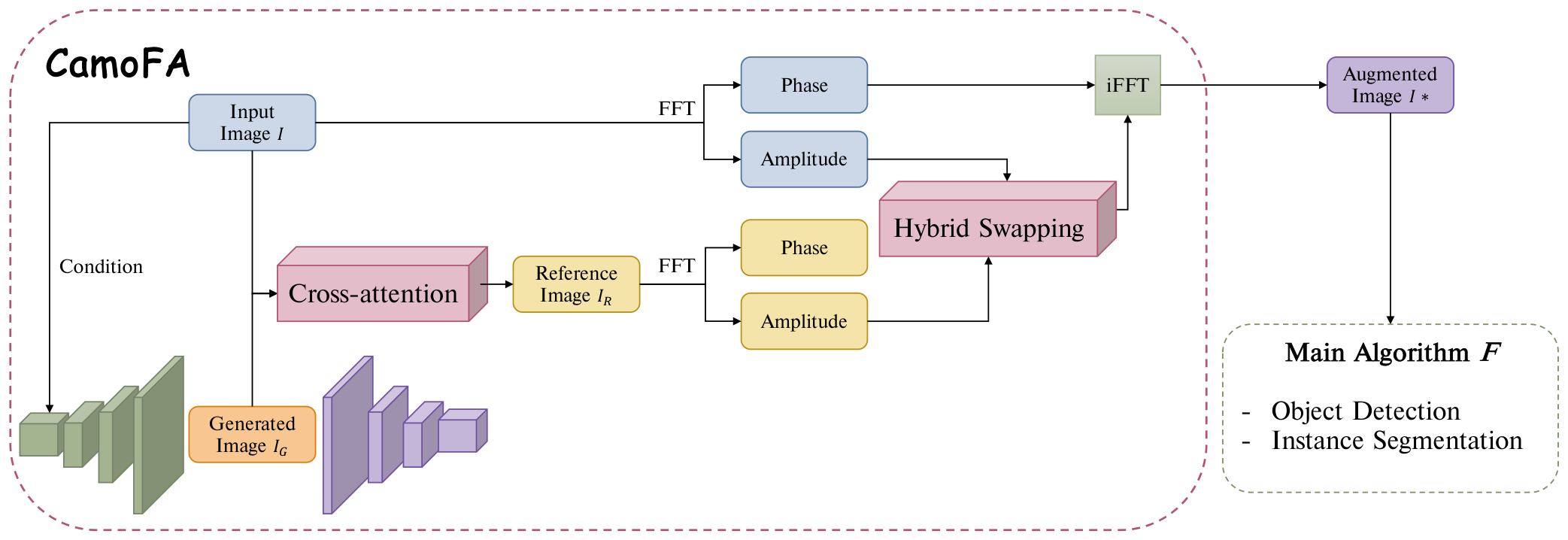
Figure 2. Overview of the proposed CamoFA. Our method leverages a conditional generative adversarial network and cross-attention mechanism to generate a reference image and an adaptive hybrid swapping with parameters to mix the low-frequency component of the reference image and the high-frequency component of the input image.
Table 1. The effectiveness of our CamoFA in improving camouflaged object detection models on three benchmarks: CAMO [19], COD10K [8], and NC4K [22]. Our CamoFA drastically increases the performance of cutting-edge methods of COD, improved results are highlighted in blue color.
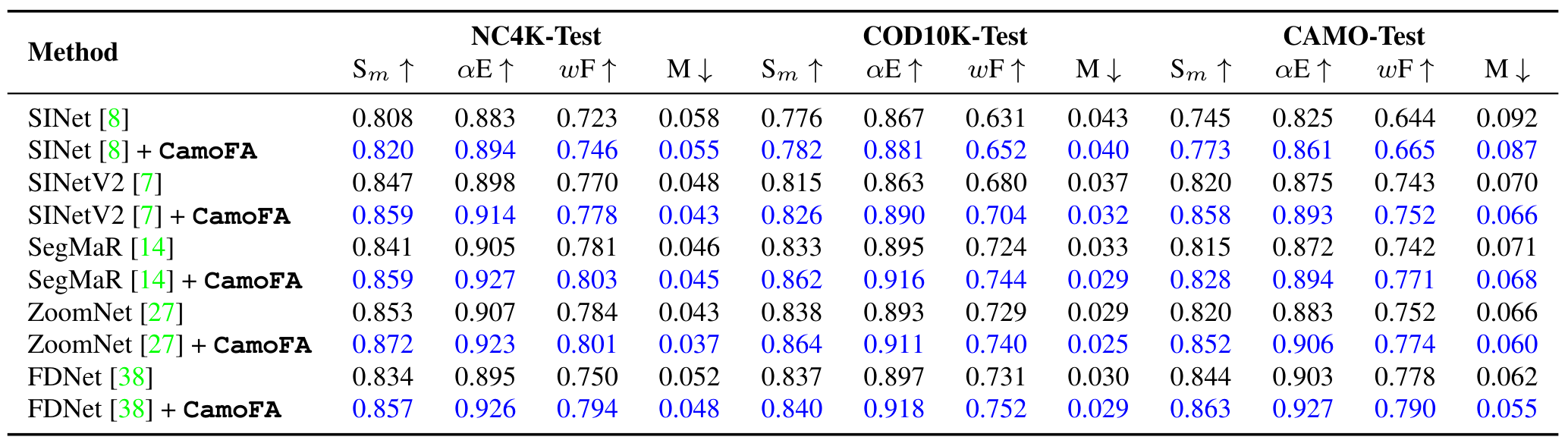
Across NC4K-Test, COD10K-Test, and CAMO-Test, adding CamoFA improves all four reported metrics for each of the five detectors. For example, SINetV2 on NC4K-Test rises from 0.847 to 0.859 in Sm while M falls from 0.048 to 0.043.
Table 2. Effectiveness of our CamoFA in improving CIS model OSFormer [28] and generic instance segmenters on two benchmarks: COD10K [8] and NC4K [22]. Our CamoFA significantly boosts the performance of state-of-the-art methods and improved results are highlighted in blue color.
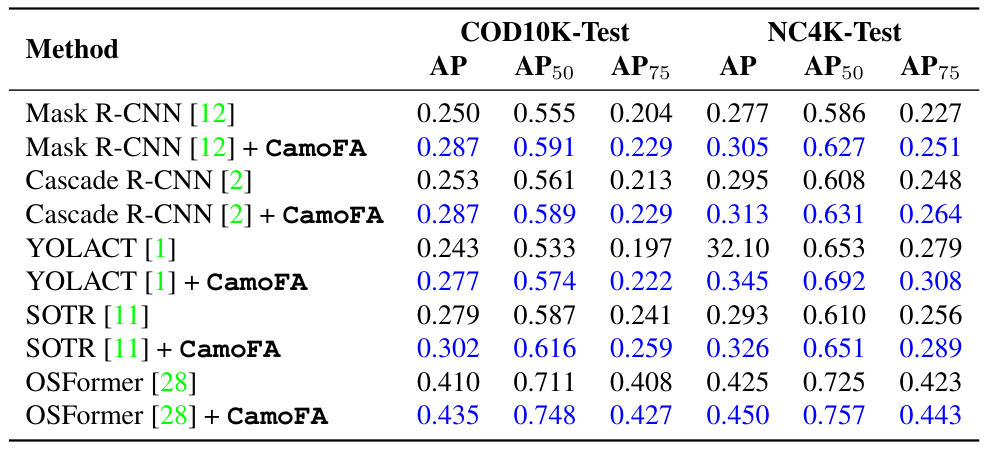
Adding CamoFA improves AP, AP50, and AP75 for the evaluated CIS models on COD10K-Test and NC4K-Test. For Mask R-CNN, COD10K-Test AP rises from 0.276 to 0.288; for OSFormer, it rises from 0.424 to 0.435.
Table 3. Comparisons between our CamoFA and existing generic augmentation methods in the camouflaged object detection task. Cutting-edge augmentations show ineffectiveness when applying to COD while our CamoFA boosts the performance of SINetV2 [7] significantly.
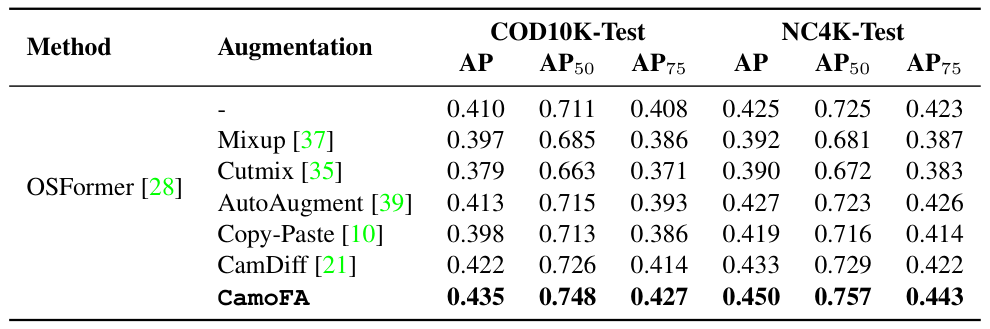
On SINetV2, CamoFA reaches 0.435 AP on COD10K-Test and 0.450 on NC4K-Test, exceeding the listed augmentation methods on both datasets. The caption notes that common augmentations can be ineffective for COD.
Table 4. Comparisons between our CamoFA and existing generic augmentation methods in CIS task. State-of-the-art generic augmentations downgrade the effectiveness of OSFormer [28] while our CamoFA drastically improves CIS models' performance.
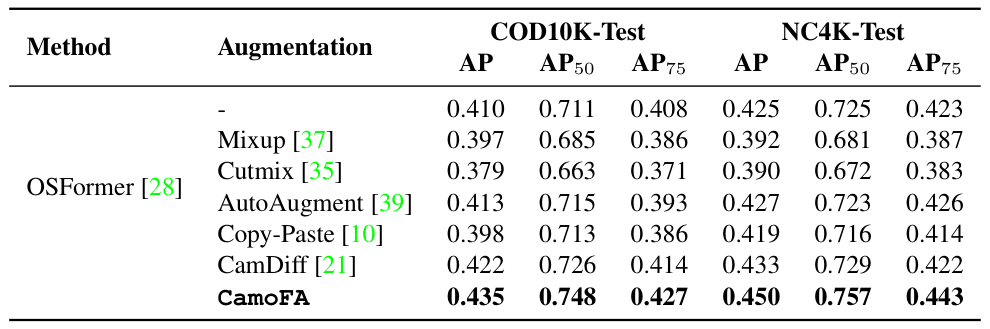
For OSFormer, CamoFA reaches 0.435 AP on COD10K-Test and 0.450 on NC4K-Test, higher than the other listed augmentation methods. The paper reports that generic augmentations can reduce OSFormer’s performance.
Table 5. Our ablation study in the task of camouflaged object detection. CamoFA with a cross-attention mechanism and adaptive hybrid swapping achieves the best performance when plugged into SINetV2 [7] and ZoomNet [27].
For both SINetV2 and ZoomNet, the setting with cross-attention and hybrid swapping gives the strongest reported results overall. SINetV2 reaches 0.826 Sm on COD10K-Test and ZoomNet reaches 0.864; the table also shows gains from adding either component alone.
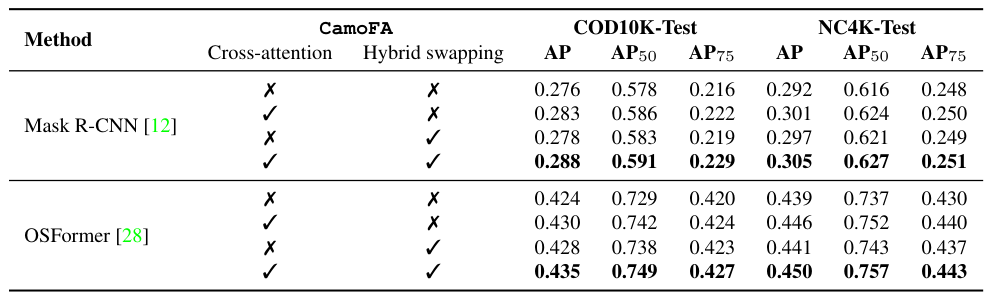
Table 6. Our ablation study in the task of camouflaged instance segmentation. CamoFA with cross-attention mechanism and adaptive hybrid swapping achieves the best performance when plugged into OSFormer [28] and Mask R-CNN [12].
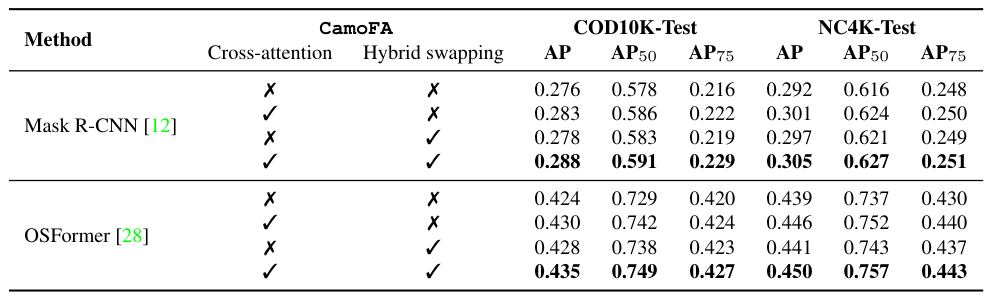
For Mask R-CNN and OSFormer, enabling both cross-attention and hybrid swapping yields the strongest reported AP values across COD10K-Test and NC4K-Test. Mask R-CNN reaches 0.288 and 0.305 AP, while OSFormer reaches 0.435 and 0.450 AP on those datasets.
CamoFA improves detection and instance segmentation results across the reported benchmarks. Its adaptive hybrid swapping also produces more accurate qualitative segmentation results than the compared models without CamoFA.
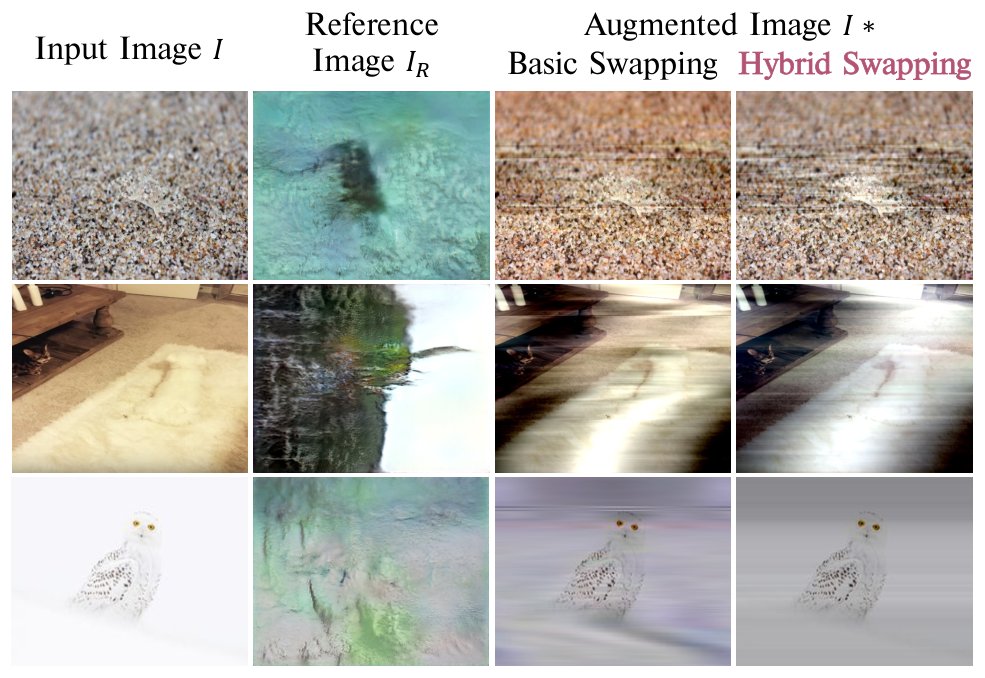
Figure 3. Visualization of augmented images by our CamoFA. Our proposed augmentation highlights the underlying structure of camouflaged objects for better identification and segmentation. We also compare the transformed results of our method with and without adaptive hybrid swapping. Our adaptive hybrid swapping can control the amount of texture and color information that is transferred from the reference image to the input image.
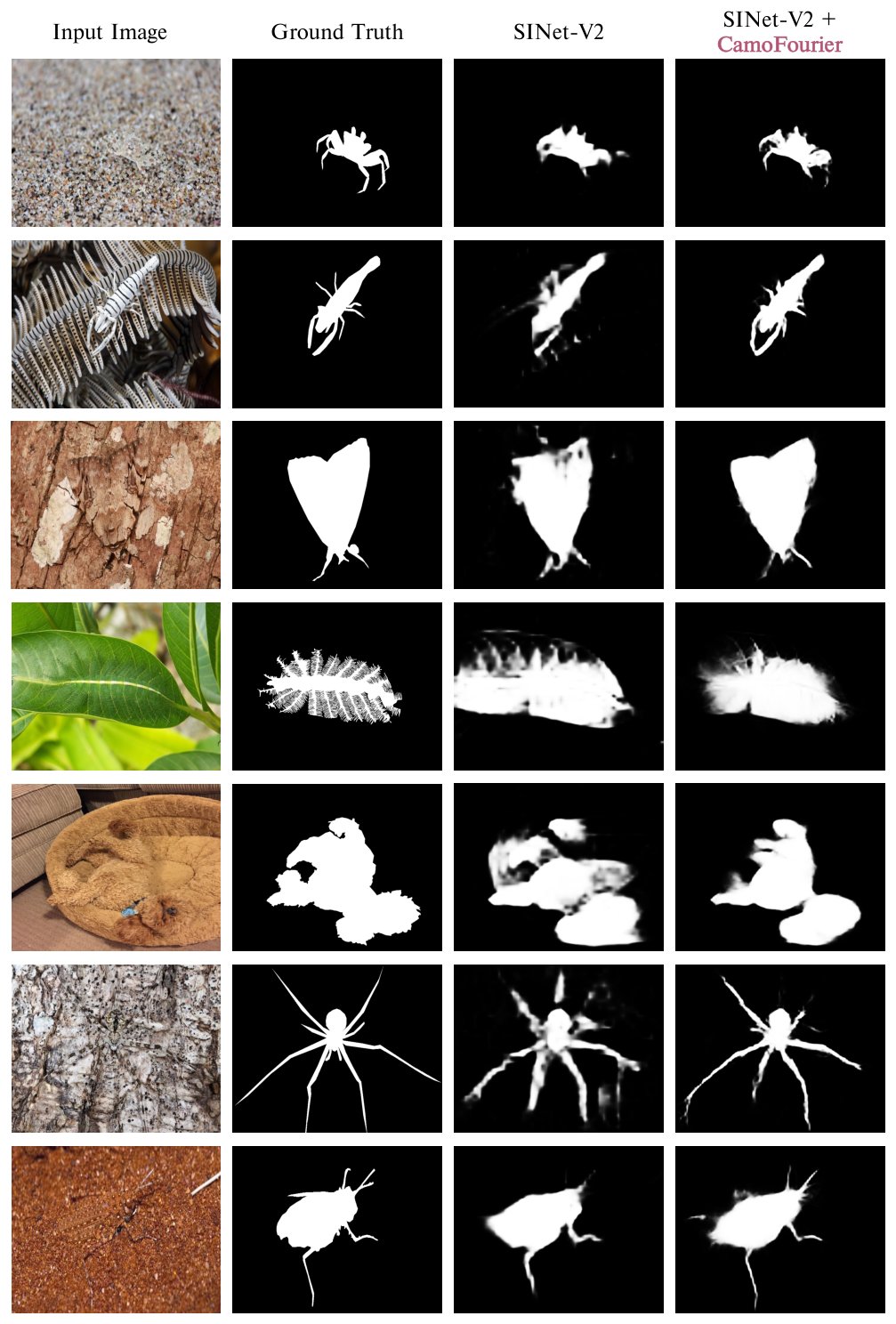
Figure 4. Qualitative comparison of SINetV2 with and without our proposed CamoFA in COD task.
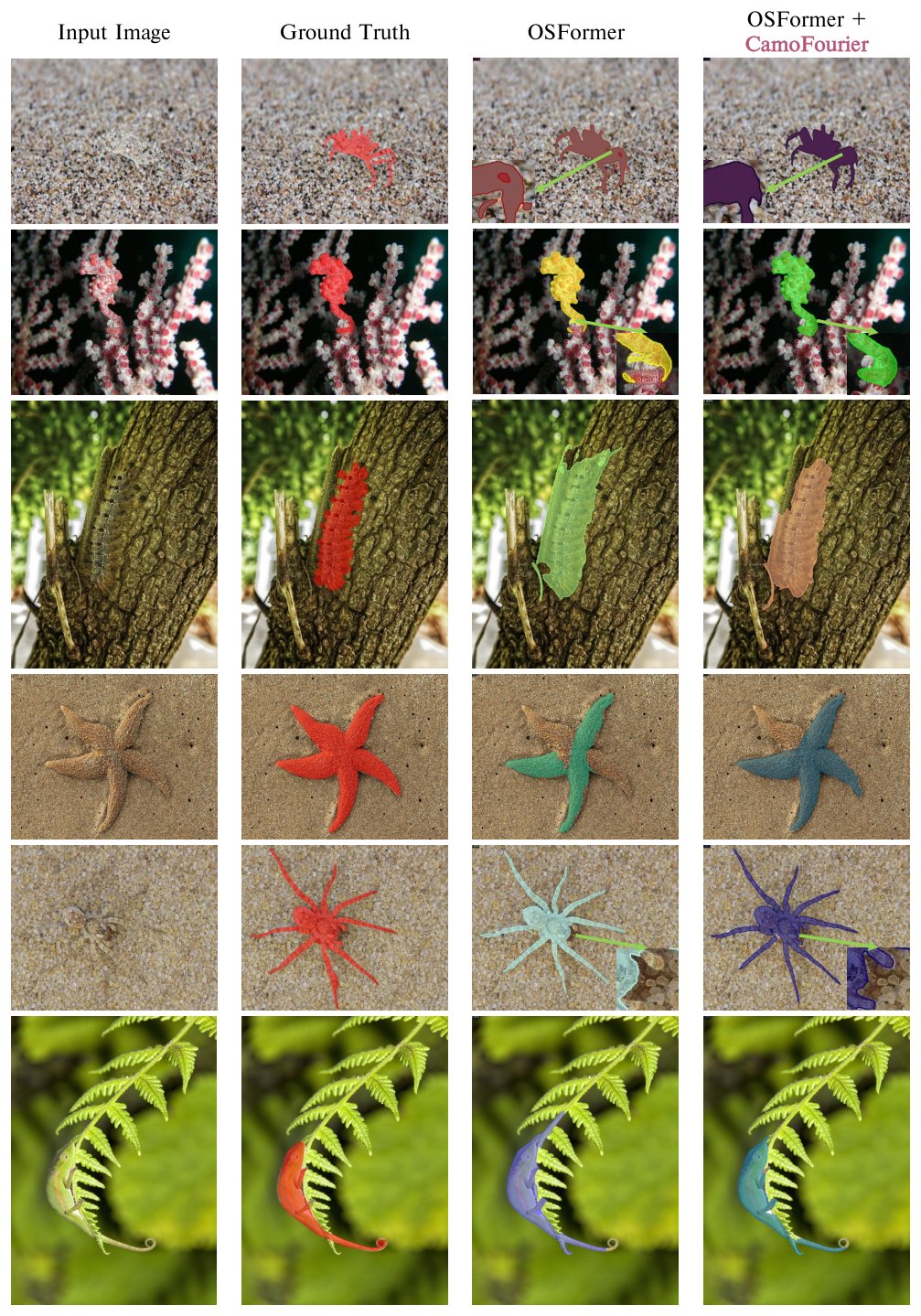
Figure 5. Qualitative comparison of OSFormer with and without our proposed CamoFA in CIS task.
@inproceedings{le2025camofa,
  author    = {Le, Minh-Quan and Tran, Minh-Triet and Le, Trung-Nghia and Nguyen, Tam V. and Do, Thanh-Toan},
  title     = {CamoFA: A Learnable Fourier-based Augmentation for Camouflage Segmentation},
  booktitle = {Winter Conference on Applications of Computer Vision (WACV)},
  year      = {2025},
}